
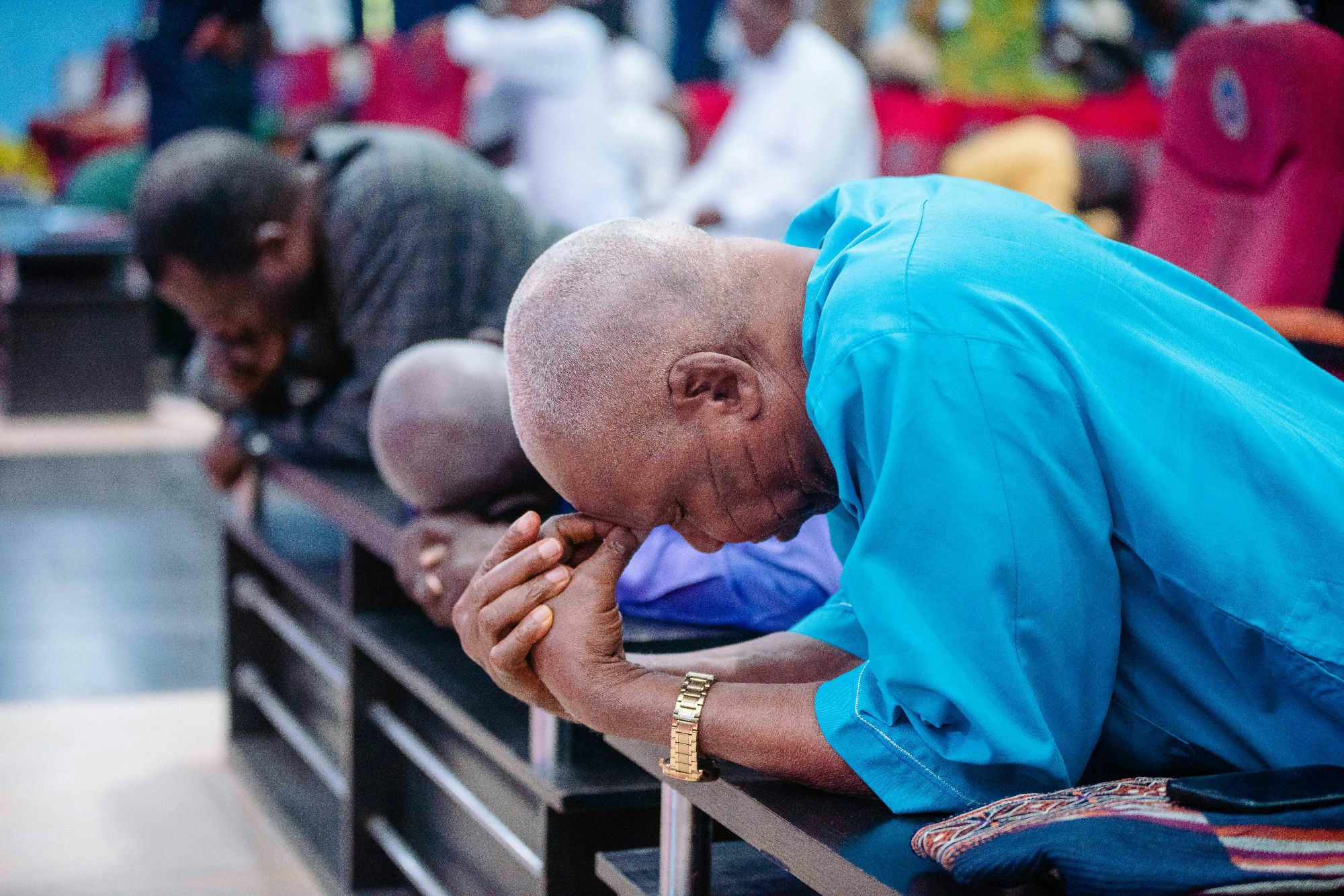

Weekly Blog - 18 March 2026 - Are Christians in Nigeria being persecuted?
The persecution of Christians in Nigeria has cropped up repeatedly in news and social media feeds in recent months. Standing with our brothers and sisters who face persecution is a core part of living out our faith (Arise Manifesto, pg 62 – 64). In a special guest blog, Daniel Stevens from Open Doors explores the issues.
On Boxing Day 2025, President Donald Trump announced that “The United States launched a powerful and deadly strike against ISIS Terrorist Scum in Northwest Nigeria, who have been targeting and viciously killing, primarily, innocent Christians, at levels not seen for many years, and even Centuries!” This was the culmination of a series of posts and threats responding to the prominence the issue was gaining in the US media.
During this period most commentators rallied into two camps. One argued that the targeting of Christians in Nigeria was a reality too long ignored by the mainstream media and celebrated the US Government naming Nigeria as a ‘country of particular concern’ in the area of religious freedom. The second camp, aligning with the Nigerian Government’s position, was that the undeniably high levels of violence in northern Nigeria are not religiously motivated, and that “Framing Nigeria’s violence as Muslims killing Christians grossly misrepresents the situation”.
While nuance can get lost in the noise, apathy is a greater enemy of analysis. So, international attention creates the possibility to better understand the issues, and greater clarity in how to respond. I work for Open Doors and our World Watch List uses numbers to communicate the extent to which Christians face persecution and discrimination. Numbers don’t tell the whole story, but in the case of Nigeria, they can be a useful bridge from noise to nuance.
I start with two numbers that Open Doors published and that were very much part of the noise, as Donald Trump cited them in a Truth Social post on 31 October 2025: that of the 4,476 killings of Christians worldwide, 3,100 were in Nigeria. This was for one year, and we have more recent numbers (for the 12-month period ending 30 September 2025) that tell the same story: Nigeria accounts for over 70% of documented killings of Christians worldwide for faith-related reasons.
Contrast that with another number, seven. That is the ranking of Nigeria in our World Watch List 2026, and many find it surprising that six countries score higher in terms of the level of persecution and discrimination faced by Christians. Taken together these numbers point to seven insights about the persecution of Christians in Nigeria.
First, many Christians in Nigeria are suffering greatly. This is the foundational fact that policy makers and the church need to wake up to. The numbers are so large we can sometimes depersonalise them. Thousands of killings mean thousands of individual stories. To take just one family from Benue State in northern Nigeria: Pastor Barnabas’ brother and sister-in-law were shot to death by militants, and he was also chased out of his village and a machete attack left him injured, but emboldened to care for others in one of the camps that have emerged for the millions of Nigerians internally displaced by the violence.
Second, killings aren’t the only form of persecution. Our approach to ranking countries in the World Watch List is based on the assumption that persecution and discrimination aren’t just about violent acts, what we refer to as ‘smash’, but also the ‘squeeze’: restrictions and hostility that put pressure on Christians.
In our methodology, only one-sixth of a country’s total score is made up of violent incidents (killings, arrests, imprisonments, abductions, rape/sexual harassment, forced marriage, physical assault, forced displacement and attacks on churches, Christian institutions, homes and businesses). The rest of the scoring is based on the restrictions and discrimination that Christians experience in how they practice their faith.
What we have observed is that discrimination and marginalisation (echoing Galtung’s categories of ‘structural’ and ‘cultural’ violence) are more often used against Christians than ‘direct’ violence (for an excellent application of this framework to the case of India see Selvaraj 2025).
Third, the killings are predominantly in the northern states and central area of Nigeria, illustrated by mapping published by The Observatory of Religious Freedom in Africa (ORFA). In the southern states, where Christians are the majority, they face relatively little persecution or discrimination. This is another reason why Nigeria only ranks seventh in our World Watch List and highlights a paradox that thousands of Christians are being killed in a country with over 100 million Christians, making up nearly half of the population.
The fourth insight, that helps explain this paradox, is that the violence is largely driven by non-governmental actors. Most notably these are Boko Haram in the northeast (infamous for their mass kidnappings) and splinter groups such as the Islamic State West Africa Province (ISWAP), which has links to ISIS and which was the target of the US attacks. In the central and northwestern region, Fulani militias are the primary threat. They are responsible for nearly half of all civilian killings in the country in the last five years. No one is suggesting the federal government in Nigeria is directly orchestrating the attacks, only that it has not done enough to prevent them.
As well as being a critical point in the case of Nigeria, the centrality of non-governmental actors reflects a wider shift in the dynamics of religious persecution: it is no longer primarily a factor of governments using legal or constitutional instruments to pursue or restrict Christians, but more often a complex interplay of societal actors oppressing minorities. Governments can play an enabling role but might also be too weak to stand in the way. Nigeria is just one example of many states that are struggling to maintain the rule of law.
A fifth insight from these numbers is that the killings are faith-related but not exclusively so. This is the most important nuance that was lost in the noise of the recent debate, but something scholars of religious freedom have been identifying for some time and something, when pressed, all analysts of the situation in Nigeria would agree on.
For example, a Guardian newspaper summary framed the Fulani militia attacks as “rooted in competition over land and water, but exacerbated by ethnicity and religion”. The Islamist insurgents of Boko Haram and Islamic State West Africa Province have a much more explicitly religious rationale, but their killings of Muslims as well as Christians point to a wider set of factors that drive the violence.
In the World Watch List, we count a killing when there is a clear faith-related dimension, but recognise that killings are normally a result of multiple vulnerabilities. In the case of the killings by Fulani militias, one factor is the scarcity of resources brought on by climate change, which has driven the largely nomadic Fulani herding groups further south in search of fertile land for their cattle.
All farmers are vulnerable, but Christians are doubly vulnerable as the Fulani, when influenced by Islamist ideologies, will have an extra motivation to steal the land of “infidels”. The pattern and drivers of violence vary significantly between regions but ORFA identifies several states – most notably in the northern regions – where Christians appear to be disproportionately killed.
It is also worth noting that there have been Muslims killed by Christian local vigilantes and in retaliatory attacks, however the great majority of Muslims were killed by the same aggressors who killed Christians. This further underlines how this is not primarily a ‘Muslim-Christian’ conflict.
Sixth, the above highlights the methodological and communication challenges in telling the story of the persecution of Christians in Nigeria. If we report that in one year 3,490 Christians were killed in Nigeria for faith related reasons, we run into what one expert highlights as an assumption that religion has to be the overriding cause. One of the features of this violence is that these crimes are not prosecuted, so there is no forensic examination of motive. Instead, we have sociological analysis of what lies behind the violence, and we use the concept of vulnerability to evaluate whether the victim’s Christian identity plays a role.
The seventh insight, which flows from the concept of overlapping vulnerabilities, is that responses to stop the violence need to be multidimensional and reflect the complex security situation in northern Nigeria and the wider region. Governments and international organisations can pull on a range of levers to protect their citizens and promote the freedom of religion and belief not just in Nigeria but worldwide.
So what can we do? Defining the ‘we’ here is foundational. What many of us might have in common, is that we identify as part of the global church. And I would suggest our response should be twofold: to suffer and stand with our brothers and sisters.
The Apostle Paul used the analogy of the human body to exhort the Corinthian church that “if one part suffers, every part suffers with it” (1 Corinthians 12:26). Most of us Western Christians are not well-practised in lament, but it is an appropriate starting point when we pay attention to the horrific suffering experienced by fellow members of the Body of Christ. The lament modelled in the Psalms also includes petition and we can pray for comfort for those caught up in the violence as well as wisdom and courage for those with influence over the situation.
We can also take a stand, though this might look different depending on our opportunities to influence. In many countries policies toward Nigeria are in flux. For example, there is currently a parliamentary inquiry on the UK’s development partnership with Nigeria and the US recently announced a $2 billion investment in Nigeria’s health system with a focus on Christian health care providers, but with questions remaining about the impact of combining targeted missiles and targeted medicine. One simple way of standing with our fellow Christians in Nigeria is to sign the petition that Open Doors has organised.
Finally, if we pay close attention to what our Nigerian brothers and sisters are asking of us, it is not virtue-signalling but participating in a proclamation of a coming Kingdom. Rifkatu is the pseudonym of one Christian woman who has had to process the devastation of being kidnapped and raped. She recounts, “I used to say, ‘These Fulani militants, I will never forgive them till eternity … But I have forgiven them in my heart. And may Almighty God help them to repent’”. She weaves together an urgent plea for protection with a refusal to become caught up in a cycle of fear and hate. In an age of insecurity, grievance and identity politics, Rifkatu calls us to an advocacy that is marked by faith in a good God, a dynamic hope for justice and a shocking love for our enemies.
Blog originally published on the Security after Christendom Substack and reproduced with kind permission.
Find out more
Arise Manifesto – Find out more about how standing with our fellow Christians, and those of all faiths and none who are persecuted for their faith, is an essential part of our mission as Christians in the Arise Manifesto, Arise’s big picture, researched, Biblical, holistic and practical vision for a better world.
Take action – It’s important to read about and better understand these issues. Very important too is not just reading but taking action. Sign up to receive monthly actions from Arise that you can take by yourself, or better still with others in a local church group near you.
Latest news – Latest news from the Arise movement.
Sign up – Found this blog online, or sent it by a friend? Sign up to receive weekly blogs from Arise directly.