
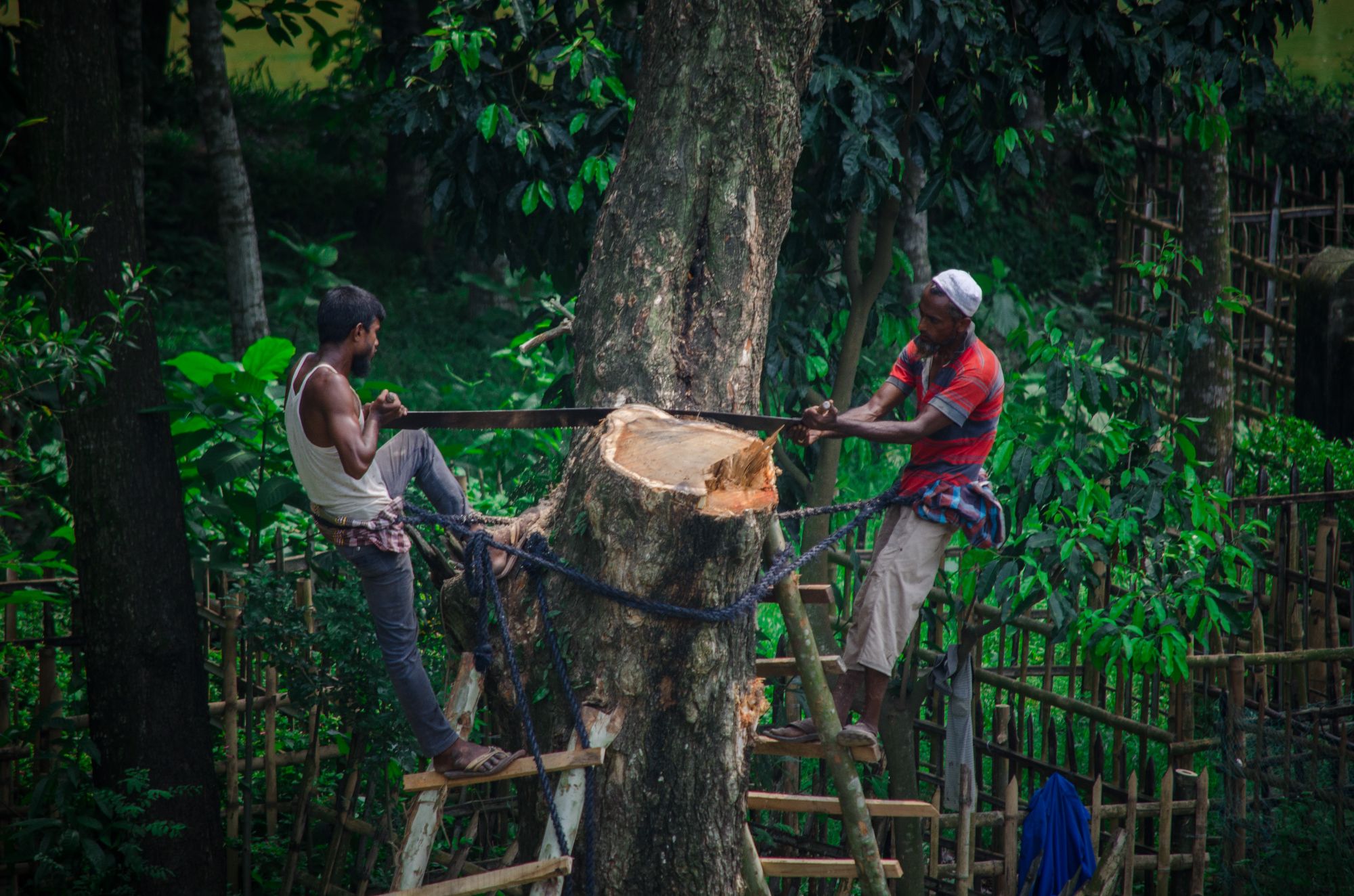

Weekly Blog - 7 August 2023 - Deforestation
Deforestation
This Tuesday 8 – Wednesday 9 August, the leaders of the world’s main rainforest nations (Bolivia, Brazil, Colombia, the Democratic Republic of Congo, Ecuador, Guyana, Indonesia, Peru, the Republic of Congo, Saint Vincent and the Grenadines, Suriname and Venezuela) met in Belem, Brazil, for a major summit on deforestation. Arise’s weekly action this week focuses on the outcomes of the summit, and our weekly blog takes a wider look at deforestation.
The global situation on deforestation appears at first glance less depressing than we might expect. The total forest area in the world is declining, but far less dramatically than in past decades, and indeed the rate is slowing. Between 1990 and 2020 the total forest area of the world declined by 4%. The 2020 Global Forest Resources Assessment, the most comprehensive and authoritative report on the state of the world’s forests conducted every five years by the UN Food and Agriculture Organization, concludes “The rate of net forest loss decreased substantially over the period 1990–2020 due to a reduction in deforestation in some countries, plus increases in forest area in others through afforestation and the natural expansion of forests.” [1] In Europe, North America and Asia, the total forest area has actually increased in recent decades. There is no case for moral superiority from these nations however. The world’s more developed and temperate regions deforested their own nations on a vast scale in the centuries when they were industrialising, but in more recent decades, as their economies have moved beyond this phase, they are doing much better at reforestation.
Much less encouragingly, if we drill down beneath the global total and just look at the world’s 30 major rainforest nations, we see a steeper rate of decline in rainforests at a global level, and in each of the three continents where they are found: Latin America, Asia and Africa. Between 1990 and 2020 the total rainforest area of the world declined by 12%. Thus denser, ancient tropical forest, which is home to a huge number of species and has more capacity to absorb CO2, is increasingly being replaced with newer, less biodiverse temperate forest which absorbs less CO2. Again the 2020 Global Forest Resources Assessment found that “More than 90 percent of deforestation in 1990–2020 was in the tropical domain”.[2]
Deforestation, especially of the world’s ancient and biodiverse rainforests, has major consequences for the environment and human health. A study from the London-based international affairs think tank Chatham House, Ending Global Deforestation found “Worldwide, more than 1.6 billion people – almost a quarter of the global population – depend on forests for at least part of their livelihoods, including for fuelwood, foodstuffs and medicinal plants. The exploitation of forests, along with other natural resources, contributes to development, but in many countries forest-management practices are clearly unsustainable, taking place at the expense of biodiversity and the natural regulation of water and climate, and undermining subsistence support and cultural values for some communities. In some countries, armed conflict has been funded by revenues from timber sales. Between 12 and 15 per cent of global greenhouse gas emissions is estimated to derive from deforestation” … “in Latin America commercial agriculture, including livestock, was the most important direct driver of deforestation, contributing around two-thirds of total deforestation. In Africa and sub-tropical Asia, commercial agriculture and subsistence agriculture accounted for around one-third of deforestation each. Mining and infrastructure development both played larger roles in Africa and Asia than in Latin America; mining accounting for about 10 per cent of deforestation in Africa and infrastructure for about 10 per cent in Africa and Asia. Urban expansion was most significant in Asia, accounting for another 10 per cent of the total, probably owing to large population growth. For forest degradation … timber and logging activities accounted for more than 70 per cent in Latin America and Asia, whereas fuelwood collection and charcoal production were the main drivers for Africa.” [3] (4 Shifts Report, pg 30 – 31, 46 – 47)
Why does this matter to us as Christians?
A major report from Arise, the 4 Shifts Report, explores what the Bible has to say about God’s creation, and our relationship with it (4 Shifts Report, pg 64 – 69). We see in this, that God’s creation is good, and it belongs to him, not us, and we should cherish and take care of it, including the rainforest. As the Bible says right back in the story of creation, “The land produced vegetation: plants bearing seed according to their kinds and trees bearing fruit with seed in it according to their kinds. And God saw that it was good.” (Gen 1: 12) Later when God’s people entered the holy land, he gave them laws to prevent the overexploitation of the creatures and plants of the land. For example, from a nest the Israelites were told, “You may take the young, but be sure to let the mother go, so that it may go well with you” (Deut 22: 7). And indeed there were laws to preserve plants and trees, thus if they found themselves besieging a city the Israelites were instructed “do not destroy its trees by putting an axe to them, because you can eat their fruit. Do not cut them down. Are the trees people, that you should besiege them?” (Deut 20: 19)
So what can be done?
To permanently end deforestation forever, the nations of the world need to shift from overconsumption and waste to a global circular economy. Our current linear economic model uses polluting methods to extract, consume, and then discard natural resources like the trees of the rainforest, faster than the planet can replenish them. We must shift to what experts call a circular economy. Just as God designed his creation so nothing is wasted in nature but gets broken down and reused in the biosphere (like we see in a rainforest), a circular economy would eliminate all pollution, overconsumption and waste and push resources back around the economy in a circular fashion, moving us back into balance with creation as God intended. Arise’s 4 Shifts Campaign calls for a shift to a circular economy as a key part of rewiring of our global economy to be green and fair, so it still creates the jobs and wealth that lift people out of poverty, but does so without relying on fossil fuels and overconsumption which is wrecking our planet.
To trigger this shift the governments of the world should negotiate a new global circular economy law. This new global treaty should revise, strengthen and incorporate the existing global agreements on the environment into a single global agreement on the circular economy. Specifically this law should ban all polluting activity, further human expansion into wild lands (such as the deforestation of the rainforest), the production of natural resources that takes out more than it puts back in (thus ensuring all logging is done sustainably, replacing the trees cut down with new ones of the same type), and all waste. It should also prevent invasive species, and invest in conservation, re-wilding and reforestation programmes, so we can grow rather than reduce the world’s precious rainforests. This law should be implemented in every nation (4 Shifts Report, pg 112 – 117).
Conclusion
Global deforestation should be a massive concern for all of us. The destruction of rainforests around the world releases an enormous amount of stored carbon into the atmosphere, accelerating global climate change, which is already at incredibly dangerous levels. It also massively reduces complex and diverse biological ecosystems that benefit the whole world, and on which the whole world, and human society, is deeply dependent. But it can be halted and reversed, for the good of God’s creation and for us all. Urgent and radical action is possible to shift from overconsumption and waste to the global circular economy that is needed. Christians should be at the forefront of pressuring governments to make that crucial shift. Get involved with Arise 4 Shifts Campaign if you want to be part of that movement. It would be a great way to support the rainforest nations on the frontline of combatting deforestation, whose major concerns were stressed in Belem, Brazil, this week.
Find out more
Find out more about why the world needs 4 Shifts to transition to a fair and green global economy in Arise’s 4 Shifts Report.
And for the bigger picture of how God is at work in the world, and the role we all have to play in that work, check out the Arise Manifesto. This is Arise’s big picture, researched, Biblical, holistic and practical vision for a better world. It looks at what the Bible says, and what we can learn from the best data and the world’s leading experts on the five major areas of evangelism, discipleship, social justice, development and the environment. It then draws these lessons together into a practical road map for the changes we need to see in our world, which the Arise movement campaigns to achieve.
Found this blog online, or sent it by a friend? Sign up to receive weekly blogs from Arise directly.
[1] Global Forest Resources Assessment 2020, FAO, (2020), pg xi, www.fao.org/3/ca9825en/ca9825en.pdf
[2] Global Forest Resources Assessment 2020, FAO, (2020), pg 18, www.fao.org/3/ca9825en/ca9825en.pdf
[3] Ending Global Deforestation, Chatham House, (2013); pg 4 – 5, www.chathamhouse.org/sites/default/files/public/Research/Energy%2C%20Environment%20and%20Development/0913pr_deforestation.pdf